
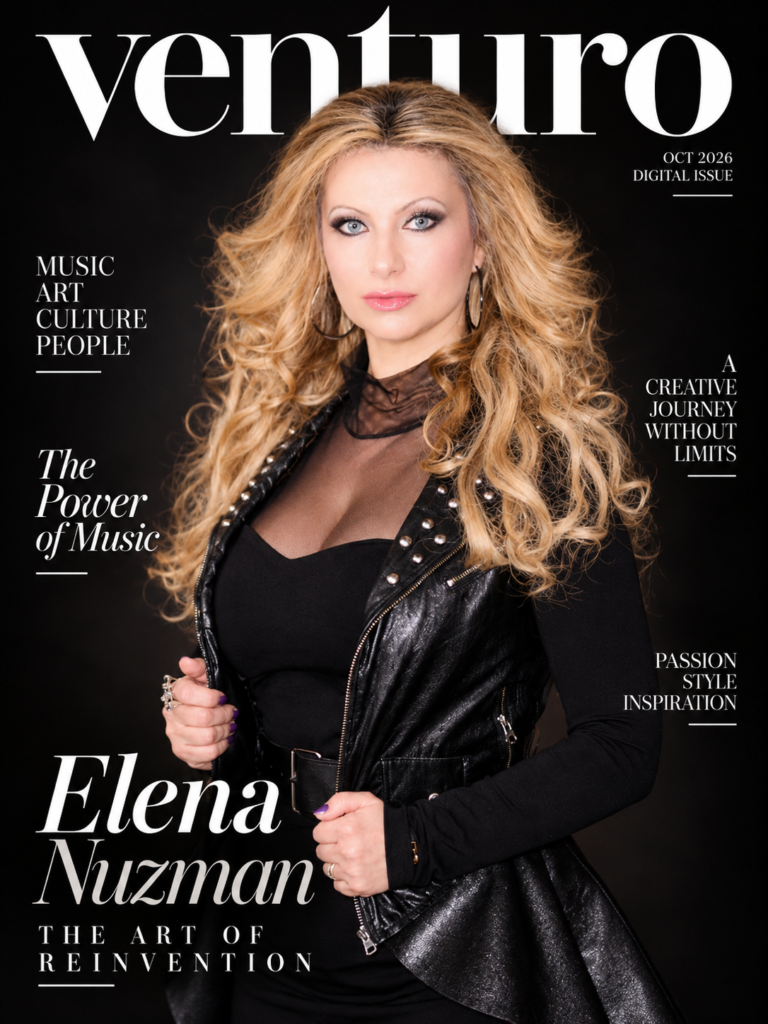

A Different Kind of Musical Journey
Some artists build their careers by perfecting a familiar sound. Others discover their greatest strengths by venturing into unfamiliar territory. Elena Nuzman has followed a path that brings these two approaches together, combining the discipline of classical piano with the expressive possibilities of contemporary singing and composition.
Her musical identity has developed through years of study, international experiences, and a willingness to challenge conventional expectations. As a concert pianist, vocalist, and composer, she has explored different ways of communicating through music while maintaining a strong connection to the instrument that first shaped her artistic life.
For Nuzman, versatility is not simply the ability to perform different genres. It is the freedom to approach each musical experience with an open mind, drawing on different influences to create something personal. Her journey illustrates how ambition becomes most meaningful when it is accompanied by curiosity, discipline, and the willingness to keep learning.
The Foundation of Excellence
Born in Moldova into a family of professional musicians, Nuzman grew up surrounded by the sounds and traditions of music. Her environment provided an early introduction to artistic expression, but her own musical instincts soon became evident.
At just two years old, she was already reproducing melodies on the piano by ear. This remarkable ability revealed an early sensitivity to musical patterns and established a connection that would continue throughout her life.
By seven, she had entered a prestigious academy for gifted students, beginning a demanding period of classical training. The experience introduced her to the discipline required to develop professional-level technique and the patience necessary to understand increasingly complex compositions.
Classical piano became the foundation of her musical education. Through years of practice, she developed an understanding of harmony, rhythm, phrasing, and interpretation. These skills demanded concentration and persistence, teaching her that meaningful progress often comes through consistent effort rather than immediate results.
Such lessons extend beyond music. The process of mastering an instrument requires an artist to remain committed even when progress is gradual, to learn from mistakes, and to approach familiar challenges with renewed attention.
These principles would eventually guide Nuzman as she explored new areas of her career.
An International Perspective
Nuzman’s development as a musician took her beyond the country where her story began. Her journey included experiences in Russia, France, the United States, Israel, and Canada, allowing her to encounter different cultural environments and broaden her artistic perspective.
International exposure can change the way musicians understand their work. Different audiences respond to performances in different ways, and unfamiliar surroundings encourage artists to reconsider how they communicate their ideas.
Nuzman continued her formal education at the Robert Schumann University of Music in Düsseldorf, Germany, where she completed a master’s degree in concert piano. The institution provided an advanced environment in which she could refine her technique and deepen her understanding of classical performance.
Her education established a strong professional foundation, but it also prepared her for a career that would eventually extend beyond traditional concert repertoire.
The ability to interpret complex music with precision would become an important resource as she moved into contemporary performance, where spontaneity and personal expression play equally significant roles.
Taking an Unexpected Direction

Although the piano had defined much of her early career, Nuzman’s artistic journey changed when she began exploring vocal performance.
A vocal competition became a turning point. Entering the Rock-Pop category, she won first prize and discovered a new opportunity to communicate through music.
Singing introduced a different kind of relationship between performer and audience. The voice carries melody and rhythm, but it also communicates through breath, tone, language, and personality. For an artist trained to express emotion through the piano, this offered another way to bring musical ideas to life.
With a reported four-octave vocal range, Nuzman developed an approach that combined the technical control of her classical background with the expressive energy of rock and pop.
Her debut album, I Believe In You, marked an important step into the contemporary music landscape. The project brought together emotional songs and rock influences, introducing audiences to a performer whose musical identity extended beyond classical tradition.
The album entered the German Newcomer Charts and remained in the Top 10 for several weeks. Her interpretation of Whitesnake’s “Here I Go Again” also reached large audiences, including those attending New Year’s Eve celebrations at Berlin’s Brandenburg Gate.
These experiences demonstrated the value of taking creative risks. By exploring a different form of performance, Nuzman expanded her artistic possibilities without losing the discipline that had shaped her from childhood.
The Power of Reinvention
For Nuzman, moving into contemporary music did not mean leaving classical music behind. Instead, she began exploring how the two traditions could inform one another.
This approach became particularly evident with Liebestraum, a project inspired by Romantic-era composers and their expressive approach to melody.
The album explored the relationship between classical piano and modern pop, allowing the emotional character of traditional compositions to influence contemporary arrangements. Rather than treating historical music as something fixed in the past, Nuzman approached it as a source of creative possibility.
The project also reflected her development as a composer. By writing many of the songs herself, she expanded her role beyond interpreting existing material and began shaping music through her own ideas.
The title track surpassed four million views on YouTube and received the IMPALA Silver Award, marking an important achievement in her career.
Its reception highlighted an interesting aspect of her artistic approach. Audiences can connect with classical influences even when they encounter them through contemporary formats. The emotional qualities of a melody can remain powerful across generations, provided the artist finds a meaningful way to communicate them.
Moving From Interpretation to Creation
Performing music and composing it require different forms of engagement.
A performer studies the intentions of a composer and develops an interpretation that communicates those ideas to an audience. A composer begins with an idea and must discover how to transform it into a complete musical experience.
Nuzman’s growing involvement in composition represents an important part of her development. Her classical training provides an understanding of musical structure, while her experience as a vocalist gives her insight into how melody and phrasing influence emotional delivery.
Together, these perspectives allow her to approach composition from multiple directions.
Creating original music also offers a degree of personal independence. Rather than working exclusively within an established repertoire, an artist can develop material that reflects individual experiences, interests, and creative instincts.
For Nuzman, composition provides another opportunity to explore the relationship between technical knowledge and personal expression.
Returning to the Instrument That Started It All
In 2025, Nuzman released My Piano And I, an album that brings her relationship with the piano back into focus.
The project includes celebrated songs, new compositions, and English versions of selected works. It reflects a musician who has expanded her artistic identity while remaining closely connected to the instrument that introduced her to music.
The piano represents continuity throughout her career. It was central to her childhood, formed the basis of her formal education, and remained important as she developed her voice and began composing.
Yet the relationship has changed through experience. The musician who once reproduced melodies by ear now approaches the instrument with years of performance, international study, and creative exploration behind her.
Returning to the piano therefore represents more than a look backward. It is an opportunity to revisit a familiar foundation with a broader perspective.
Ambition Beyond Recognition

Professional recognition can provide valuable confirmation of an artist’s achievements, but a lasting career requires more than successful albums or significant performances.
It requires the ability to continue developing when familiar skills are no longer enough. It also requires an openness to criticism, the patience to refine one’s work, and the confidence to explore possibilities that may not guarantee immediate success.
Nuzman’s career reflects this process of continuous development. Her transition from classical piano to contemporary singing, followed by her growing involvement in composition, demonstrates a willingness to learn new skills rather than rely exclusively on established strengths.
Her experience suggests that ambition is most productive when it is connected to a clear sense of purpose. Recognition may mark an important milestone, but the work of becoming a more capable and expressive artist continues beyond each achievement.
A Future Shaped by Possibility
Elena Nuzman’s story brings together several qualities that define an evolving artist: technical excellence, creative independence, and the confidence to explore unfamiliar territory.
Her journey from Moldova to international musical environments, from classical performance to rock and pop, and from interpretation to composition demonstrates that artistic identity can develop without losing its original foundations.
The piano remains central to her story, but it no longer represents the limits of what she can do. Her voice has opened another expressive dimension, while composition has allowed her to contribute original ideas to the musical landscape she inhabits.
For Venturo, Nuzman’s career offers a compelling example of what can happen when discipline and imagination work together. Her achievements reflect years of commitment, but her continuing evolution is what makes her story particularly interesting.
She has shown that mastery need not lead to repetition, and that professional experience can create the confidence to experiment rather than the pressure to remain predictable.
Elena Nuzman continues to approach music as an expanding field of possibility, where different traditions can meet and new ideas can emerge from familiar foundations. Her journey is a reminder that the most rewarding creative paths are often those that leave room for discovery, allowing ambition to grow alongside the freedom to create.