
The modern entrepreneur on leadership, innovation, responsibility, and creating businesses that matter
There is a particular kind of confidence that comes with having nothing left to prove.
It is not loud. It does not need to dominate a room or announce itself through a long list of achievements. Instead, it appears in the way someone listens, the questions they ask, and the patience they have when discussing what comes next.
Adrian Vale has that kind of confidence.
A fictional entrepreneur and business leader created for Venturo, Vale represents a new generation of executives who see business as something larger than revenue, expansion and market share. For him, building a successful company is inseparable from building a strong culture, developing people and understanding the responsibility that comes with influence.
Sitting in a high-rise office overlooking a constantly moving city, Vale speaks about entrepreneurship with surprising simplicity.
“Business is ultimately about people,” he says. “Technology changes. Markets change. Strategies change. But if you understand people, you can continue adapting.”
That philosophy has shaped the way he approaches leadership—and perhaps explains why his story feels particularly relevant at a time when the definition of business success is changing.
The Decision to Build
Vale’s journey did not begin with a grand business plan.
Like many entrepreneurs, his first experiences with business came through observation. He noticed how companies operated, how teams responded to good and bad leadership, and how seemingly small decisions could eventually determine whether an organization moved forward or stood still.
Over time, curiosity became ambition.
He began exploring different industries, studying the relationship between technology and consumers, and paying close attention to businesses that managed to grow without losing their identity.
One lesson stayed with him: growth without direction can become a problem of its own.
“It is easy to become busy,” he explains. “It is much harder to make sure that the work you are doing actually matters.”
That distinction became central to his approach.
Rather than pursuing every opportunity, Vale believes entrepreneurs should understand why an opportunity exists in the first place. Is it solving a real problem? Does it create something useful? Does it make sense for the people involved?
Those questions may sound straightforward, but they can become surprisingly difficult when a company begins to grow.
Leadership Without the Spotlight
The image of the modern CEO has changed.
The traditional executive was often presented as the person with all the answers—the individual at the top who made the final decision and expected everyone else to follow.
Vale sees leadership differently.
He believes the best leaders create environments where talented people can challenge ideas, disagree respectfully and contribute beyond their job descriptions.
“I don’t think leadership means being the smartest person in the room,” he says. “If you always have to be the smartest person in the room, you probably haven’t built the right room.”
It is a line that captures his broader philosophy.
For Vale, hiring people who think differently is not a risk to be managed. It is an advantage to be protected.
Different backgrounds create different perspectives. Different perspectives create better questions. And better questions can eventually lead to better decisions.
That does not mean every disagreement becomes a change in strategy.
Sometimes the original idea survives.
Sometimes it does not.
What matters, according to Vale, is that people feel comfortable enough to question the original idea.
The Human Side of Innovation
Innovation has become one of the most frequently used words in business.
Almost every industry claims to be innovative. Every major conference features panels about disruption. Every new technology arrives with promises of transforming the way people live and work.
Vale is interested in innovation, but he is cautious about the word itself.
“New doesn’t automatically mean better,” he says.
His approach begins with the problem rather than the technology.
A company should not adopt a new system simply because competitors are using it. It should understand what the technology is supposed to improve.
That mindset has become particularly important as artificial intelligence, automation and digital platforms continue to reshape industries.
Vale believes technology can remove unnecessary work, improve decision-making and create opportunities that previously did not exist. But he also believes organizations should remain conscious of what technology cannot replace.
Trust.
Creativity.
Judgment.
Human relationships.
“These tools should make people more capable,” he says. “They shouldn’t make people feel less important.”
Building a Culture That Lasts
For Vale, company culture is not a slogan printed on an office wall.
It is what happens when nobody is watching.
It is how managers treat junior employees. It is how teams respond when something goes wrong. It is whether people receive credit for their work. It is whether employees can admit that they made a mistake without immediately fearing the consequences.
Creating that kind of culture takes time.
It also requires consistency.
Vale believes executives sometimes underestimate how closely employees watch their behavior.
If a leader talks about balance but rewards people for working constantly, employees notice.
If a company says creativity matters but rejects every unconventional idea, employees notice.
If an organization says people are its greatest asset but never invests in them, employees notice.
“Culture isn’t what you say your company believes,” Vale explains. “Culture is what people experience every day.”
That belief has influenced his approach to hiring, management and growth.
Success Beyond Numbers
Financial performance remains essential to any business.
Vale is the first to acknowledge that.
A company cannot create jobs, develop products or serve customers indefinitely without financial stability. Profitability provides the foundation for continued investment.
But he believes numbers tell only part of the story.
A business should also consider the quality of the experience it creates for customers and employees.
Does the product genuinely help someone?
Are employees developing new skills?
Is the organization becoming more resilient?
Does growth create value beyond the company’s balance sheet?
These questions have become increasingly important to the new generation of business leaders.
Consumers are paying closer attention to the companies they support, while employees increasingly consider purpose, flexibility and culture alongside compensation.
Vale sees that shift as an opportunity rather than an obstacle.
“People want to know what they are participating in,” he says. “They want their work and their choices to mean something.”
Learning From Failure
No entrepreneurial story is complete without failure.
Vale does not romanticize it.
Failure can be expensive, frustrating and personally difficult. It can affect employees, investors and customers, not just the person sitting in the CEO’s chair.
But he believes entrepreneurs can learn more from a difficult decision than from an easy victory.
The important thing is to examine what actually happened.
Was the strategy wrong?
Was the timing wrong?
Was the team missing information?
Did the company move too quickly?
Or did circumstances change in a way nobody could reasonably have anticipated?
The answers matter because they determine what happens next.
Vale’s approach is to separate the emotional experience of failure from the analytical process of learning from it.
“You are allowed to be disappointed,” he says. “But eventually you have to ask better questions.”
That attitude has helped him view setbacks not as defining moments, but as information.
A Different Kind of Ambition
There is no shortage of ambition in modern business.
Companies want to grow faster. Founders want to build bigger organizations. Investors want stronger returns. Markets reward scale.
Vale’s ambition is slightly different.
He wants to build something that can outlast him.
That means developing leaders who can eventually make decisions without him. It means creating systems that do not depend on one personality. It means building a brand that has a clear identity even when the original founder is no longer involved in every decision.
For an entrepreneur, that can be difficult.
Giving away responsibility requires trust.
But Vale believes it is necessary.
“If everything depends on you, you haven’t really built a company,” he says. “You’ve built a job that happens to have employees.”
It is perhaps his clearest definition of sustainable leadership.
The Next Chapter
Looking toward the future, Vale remains interested in technology, entrepreneurship and global business, but he speaks less about specific targets than about possibilities.
He sees enormous opportunities in the intersection between technology and human creativity.
Artificial intelligence will continue to change how companies operate. New business models will emerge. Consumers will become more demanding. Industries that appear stable today may look completely different within a decade.
For Vale, that uncertainty is exciting.
He does not believe successful leaders need to predict the future perfectly.
They need to be prepared to respond to it.
That means remaining curious.
It means listening to customers.
It means investing in people.
It means being willing to abandon an idea when evidence shows that it no longer works.
And perhaps most importantly, it means accepting that leadership is a process rather than a destination.
Building What Comes Next
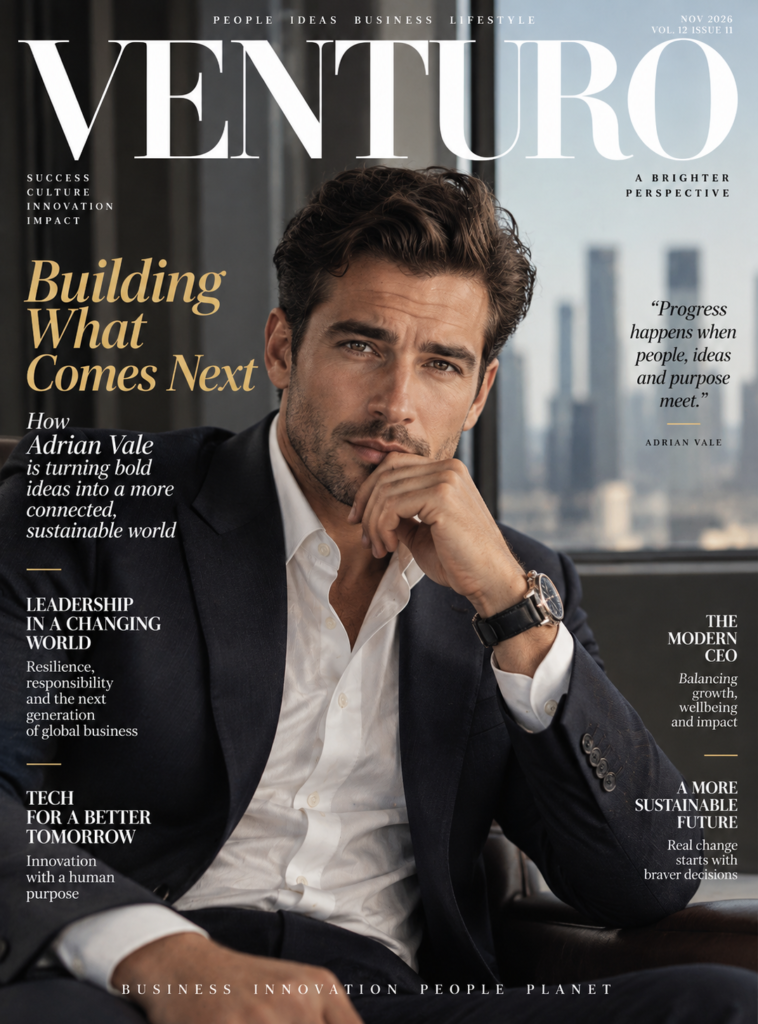
The phrase on this month’s Venturo cover—“Building What Comes Next”—is more than a headline for Adrian Vale.
It captures his view of entrepreneurship.
The future is not something that simply arrives. It is shaped by decisions made today: what companies build, who they hire, what problems they choose to solve and what kind of culture they create along the way.
Vale’s fictional journey represents a broader idea about modern business leadership: success is no longer defined only by how quickly an organization grows, but also by what it contributes while growing.
The most interesting businesses of tomorrow may not necessarily be the loudest.
They may be the ones that understand their customers deeply, use technology thoughtfully, develop their people and remain flexible enough to evolve.
For Vale, that is the challenge—and the opportunity.
The city outside his window continues to change. New buildings rise. Old businesses disappear. New ideas become industries.
There is no permanent version of success.
There is only the next decision.
And for Adrian Vale, the next decision is always the beginning of the next chapter.
That is what building what comes next really means.