
The model, creative entrepreneur and modern tastemaker on ambition, discipline, identity, and creating a life with meaning
There is a certain ease to Noah Rivelli that is difficult to manufacture.
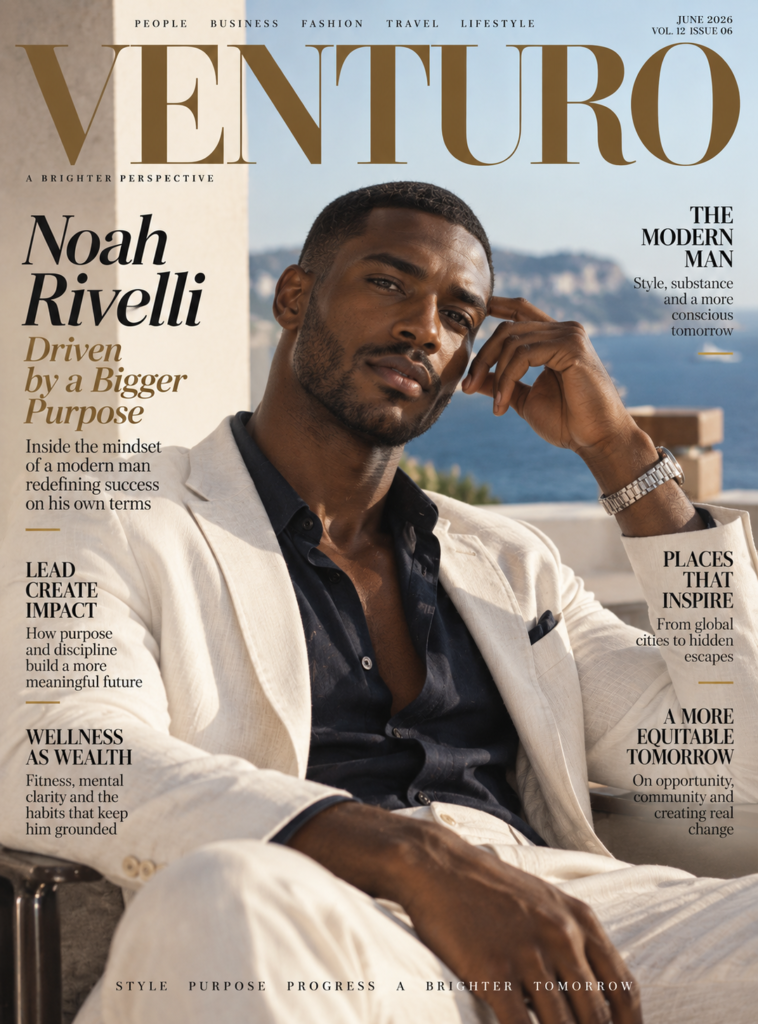
Whether he is standing in front of a camera, walking into a room filled with industry professionals, or simply sitting quietly overlooking the sea, he carries himself with the kind of confidence that does not ask for permission. It is measured rather than loud, considered rather than calculated.
For Rivelli, style has always been part of the story, but it has never been the entire story.
The fictional model and creative personality featured on the June 2026 cover of Venturo represents a different idea of modern masculinity—one built around ambition without arrogance, discipline without obsession, and success without losing sight of the person behind it.
His career has taken him into fashion, lifestyle and creative projects, but what interests him most now is the opportunity to build something that exists beyond a photograph.
“I’ve always wanted to do more than be in front of the camera,” Rivelli says. “Modeling opened the door, but it also showed me how many different creative worlds exist behind it.”
That curiosity has become one of the defining characteristics of his journey.
A Career Built on Curiosity
Rivelli’s relationship with modeling began with a fascination with images.
He was drawn to the way a photograph could communicate an entire personality without a single word. A change in lighting could completely alter the mood. A different location could turn a simple outfit into a story. A photographer could capture something in a person that they did not even realize they were expressing.
At first, modeling was simply an opportunity to explore that world.
With time, it became a profession—and eventually, a platform.
The transition was not always easy.
The fashion industry can be unpredictable. Jobs come and go. Trends change quickly. Rejection is part of the process, even for people who appear to have effortless careers from the outside.
Rivelli learned early that consistency mattered more than a single opportunity.
“You can’t build a career around one good day,” he says. “You have to keep showing up.”
That mentality has followed him throughout his professional life.
The Discipline Behind the Image
The polished photograph is often the part of modeling audiences see.
They see the clothes, the location, the lighting and the finished image.
They rarely see everything that happens before the shutter clicks.
There are early mornings, fittings, travel, workouts, rehearsals, waiting and countless hours spent preparing for a few minutes in front of a camera.
Rivelli does not complain about that reality.
Instead, he sees discipline as one of the foundations of creative freedom.
For him, taking care of his body is not about trying to achieve an impossible standard. It is about having energy, confidence and the ability to perform when an opportunity arrives.
His routine combines movement, fitness, rest and a conscious approach to nutrition, but he is equally interested in mental discipline.
He believes that learning when to switch off is just as important as learning when to push harder.
“In this industry, you can always feel like you need to do more,” he says. “At some point, you have to understand that recovery is part of the work too.”
It is an attitude that reflects a broader change in conversations around men’s wellness.
Strength is no longer defined only by physical appearance. Increasingly, it includes emotional awareness, balance and the ability to recognize personal limits.
Redefining Success
Rivelli’s understanding of success has changed as his career has developed.
Earlier in his journey, success was closely connected to opportunity: bigger campaigns, better clients, international travel and recognition.
Those things still matter.
But they no longer define the destination.
Today, he measures success through freedom.
Freedom to choose projects.
Freedom to spend time with people he values.
Freedom to explore ideas without worrying about whether every decision will immediately produce a financial return.
And perhaps most importantly, freedom to walk away from opportunities that do not align with the person he is becoming.
“Success should give you more control over your life,” he says. “If you’re successful on paper but you don’t have time to live, I don’t know if that feels like success.”
It is a surprisingly simple philosophy in an industry that often celebrates excess.
The Modern Man
The idea of masculinity is changing.
The old image of the successful man was often built around status, competition and emotional distance.
Rivelli represents a more contemporary interpretation.
He is ambitious, but does not believe ambition requires constant competition.
He values appearance, but does not believe appearance determines worth.
He is interested in business, but does not believe money should be the only measure of achievement.
For him, being a modern man means being comfortable with complexity.
“You can be ambitious and still be kind,” he says. “You can be strong and still admit that you don’t know something. I don’t think those things contradict each other.”
That perspective has influenced the way he approaches both professional and personal relationships.
He believes listening is an underrated leadership skill and that confidence does not disappear simply because someone else has a better idea.
In fact, he believes the opposite.
The most confident people, he suggests, are often the ones who do not feel threatened by other people’s strengths.
Fashion With Substance
Fashion remains an important part of Rivelli’s identity.
His personal style is understated, often relying on strong tailoring, natural fabrics and pieces that can move between different environments.
He prefers clothing that looks intentional without appearing overly constructed.
A well-cut jacket.
A simple shirt.
A good watch.
A pair of shoes that can survive a long day.
For Rivelli, style is about understanding what works rather than constantly following what is new.
Trends can be fun, but personal style requires something deeper.
“Clothes should support your personality,” he says. “They shouldn’t become your personality.”
That philosophy extends to the way he thinks about luxury.
The most valuable things, in his view, are not necessarily the most expensive.
A memorable trip.
A meaningful conversation.
An afternoon without a schedule.
Time with family and friends.
Those experiences become increasingly important as life becomes busier.
Traveling With Purpose
Travel has played a major role in Rivelli’s development.
The destinations connected to his work have introduced him to different cultures, creative communities and ways of living.
But he does not approach travel simply as a checklist of beautiful locations.
He prefers to stay long enough to understand a place.
Walk rather than always drive.
Eat where locals eat.
Explore neighborhoods away from the obvious tourist routes.
Pay attention to architecture.
Talk to people.
He believes travel becomes meaningful when it changes the way you see your own life after returning home.
“Every city teaches you something,” he says. “Sometimes it’s about the place. Sometimes it’s about yourself.”
The idea fits naturally with the Venturo philosophy of looking beyond appearances.
A destination is not simply a background for a photograph. It is a collection of people, stories and experiences.
Building Beyond Modeling
Rivelli is increasingly interested in entrepreneurship and creative collaboration.
The transition from model to entrepreneur is not unusual, but it requires an entirely different set of skills.
Being photographed is one thing.
Building a product, managing a team or developing a business requires patience, organization and the ability to make decisions without knowing exactly what will happen next.
Rivelli understands that the learning curve is steep.
He is not interested in pretending to have every answer.
Instead, he approaches business with the same curiosity that originally attracted him to modeling.
Ask questions.
Find people who know more.
Experiment.
Learn fr